In Pasadena California, many times we see projects underestimating the effect of the Raymond Fault zone on shallow foundations. The city sits on a mix of alluvial fan deposits and older terrace gravels, which produce variable bearing conditions within a single lot. Our Factor of Safety (FS) calculation integrates site-specific shear strength parameters from triaxial and direct shear tests, then cross-references them with the seismic coefficients from ASCE 7-22. This avoids the common pitfall of using generic soil profiles that can lead to FS values below 1.5 under seismic loading. For deep excavations, we complement this with a slope stability analysis to account for temporary cuts in the granular soils typical of the San Gabriel Valley.
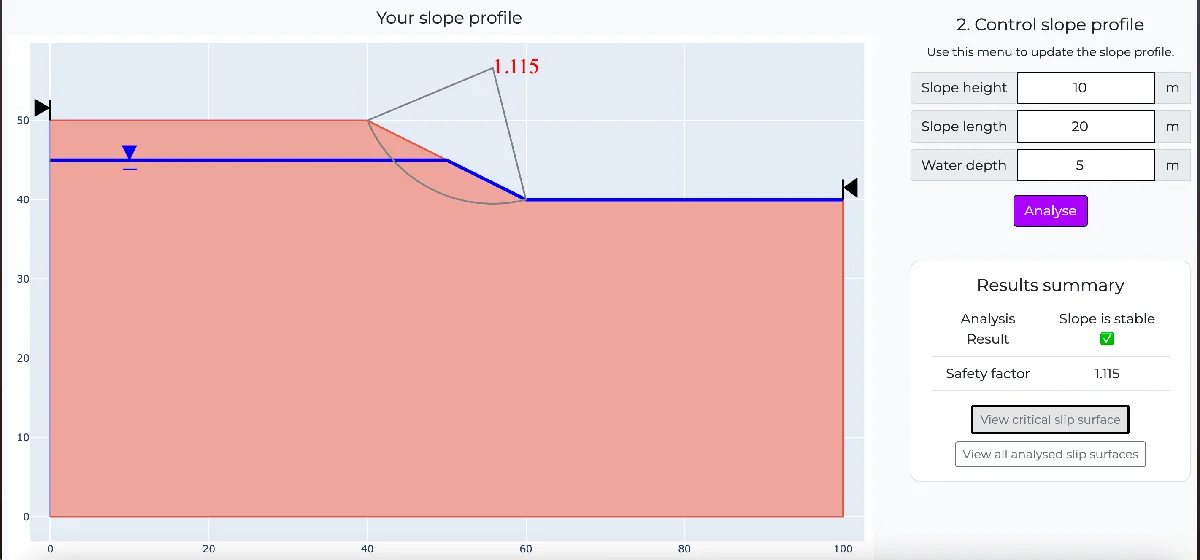
A factor of safety below 1.5 under seismic loading indicates the foundation design must be revised before construction documents are finalized.
Service characteristics in Pasadena California
- Determination of ultimate bearing capacity via Terzaghi or Vesic methods depending on depth-to-width ratio
- Seismic site classification per ASCE 7-22 using measured Vs30 from our MASW surveys
- Assessment of liquefaction-induced settlement using the NCEER simplified procedure
Critical ground factors in Pasadena California
The surface geology of Pasadena California consists of young alluvium overlying the Raymond Fault shear zone, which creates abrupt lateral changes in soil stiffness. During the 1971 San Fernando earthquake, several structures in the central basin experienced differential settlements because the factor of safety against bearing failure dropped below 1.0 in the liquefiable silt lenses. The same lenses reappear in geotechnical borings across the city, particularly east of Arroyo Seco. Ignoring these layers during the FS calculation can produce an overestimated capacity by 40% or more. Our team always requires at least one CPT sounding to capture the continuous stratigraphy before finalizing the global stability number.
Our services
We offer two specialized operations to determine and verify the Factor of Safety (FS) for your Pasadena California project, each tailored to the local geology.
Static and Seismic FS Verification for Foundations
Complete bearing capacity and settlement analysis using SPT, CPT, and laboratory triaxial data. We compute the factor of safety for shallow and deep foundations under both gravity and seismic loads, referencing IBC 2021 and ASCE 7-22. Deliverables include a signed calculation report with FS values at each exploration point.
Slope and Retaining Wall Stability with FS Determination
Limit equilibrium analysis using Bishop and Spencer methods for cut slopes and MSE walls. We incorporate pore pressure ratios and seismic coefficients to produce a reliable factor of safety. The service includes sensitivity analysis for varying groundwater levels, typical of Pasadena's seasonal rainfall patterns.
Common questions
What is the minimum acceptable factor of safety for a shallow foundation in Pasadena California?
For static loading, IBC 2021 and most local geotechnical reports require a minimum FS of 2.0 against bearing failure. Under seismic conditions, the FS can be reduced to 1.1 provided the soil does not liquefy and the foundation is designed per ASCE 7-22.
How much does a factor of safety calculation cost in Pasadena California?
A complete FS calculation including field testing and laboratory work typically ranges between US$660 and US$1,790. The final cost depends on the number of borings, required laboratory tests, and the complexity of the site stratigraphy.
What soil parameters are needed to compute the factor of safety?
You need drained or undrained shear strength parameters (c' and phi'), unit weight, groundwater depth, and seismic site class. For Pasadena California, we also recommend including the plasticity index to estimate cyclic strength loss in fine-grained soils.
Can the factor of safety change after construction starts?
Yes. If excavation reveals unexpected soil conditions like undocumented fill or perched water, the original FS must be recalculated. That is why we recommend a geotechnical monitoring program during excavation to verify assumptions in real time.