A common mistake we see in Pasadena California is contractors assuming the same compaction effort works for all soil types. The alluvial fan deposits from the San Gabriel Mountains create a mix of gravelly sands, silty clays, and colluvium that each require a different optimum moisture content. Without a site-specific Proctor test, you risk placing fill at the wrong water content, leading to settlement under slab loads or pavement failure within two years. We run both Standard (ASTM D698) and Modified (ASTM D1557) curves depending on the energy level your design requires. For projects near the Arroyo Seco, where native soils vary laterally every 50 feet, we combine the Proctor results with a placa de carga to verify field density and modulus against the curve.
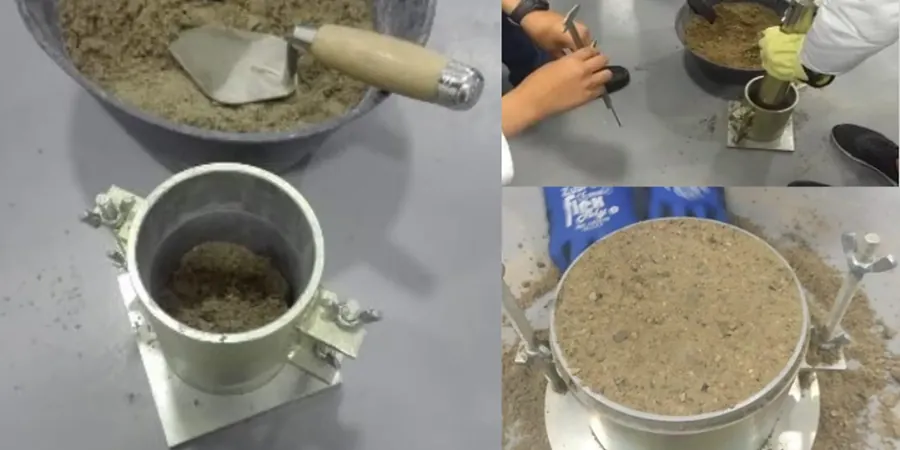
A site-specific Proctor curve prevents the two most common field failures: pumping under compaction passes and long-term settlement after wetting.
Service characteristics in Pasadena California
Critical ground factors in Pasadena California
A 40-unit condo project near the Pasadena City Hall replaced 12 feet of undocumented fill with engineered import. The contractor used a generic compaction curve from a textbook, assuming a 95% relative compaction target. After the first winter rain, the slab edges settled 1.5 inches, cracking the facade and shearing the utility connections. A proper Modified Proctor test on the actual import material would have shown that the optimum moisture was 3% higher than the generic curve predicted, and the contractor was compacting too dry. The repair cost exceeded what a full Proctor study would have cost by a factor of twenty. That is the kind of lesson that sticks.
Our services
We offer four compaction-related operations to cover the full spectrum of earthwork control in Pasadena California:
Standard Proctor Test (ASTM D698)
For residential fills, parking lots, and light commercial slabs where compactive effort is moderate. We deliver the compaction curve within three business days.
Modified Proctor Test (ASTM D1557)
For highway embankments, deep fills, and heavy industrial floors requiring higher density. The Modified curve reflects roller passes typical of large earthmoving equipment.
Field Density Verification (ASTM D6938)
Nuclear gauge or sand-cone density tests to compare field moisture and dry density against the Proctor curve. We issue pass/fail reports per lift.
Oversize Correction (ASTM D4718)
When soil contains more than 30% gravel retained on the 3/4-inch sieve, we apply the correction method to adjust the compaction curve for the scalped material.
Common questions
What is the difference between Standard and Modified Proctor in Pasadena California?
The difference is compactive effort. Standard Proctor (ASTM D698) applies 12,400 ft-lbf/ft³ and is used for light fills and residential work. Modified Proctor (ASTM D1557) applies 56,000 ft-lbf/ft³, simulating heavy roller compaction for highways and structural fills. The Modified curve typically yields a higher maximum dry density and a lower optimum moisture content.
How much does a Proctor test cost in Pasadena California?
A standard Proctor test typically ranges from US$100 to US$230 per sample, depending on whether you need Standard or Modified effort, and whether oversize correction is required. The price includes the compaction curve, moisture-density relationship, and a written report. Volume discounts apply for multiple samples from the same project.
When is a Modified Proctor required instead of Standard?
The Modified Proctor is required when the design specifications call for a compaction target above 95% relative density, or when the earthwork will be subjected to heavy traffic loads, deep fills over 10 feet, or seismic lateral pressures. Pasadena California projects near fault zones or on steep slopes often specify Modified compaction to reduce long-term settlement risk.