Pasadena sits on the Raymond Fault system and has experienced moderate shaking from the 1971 Sylmar and 1994 Northridge earthquakes. The local soil profile varies from alluvial fans near the San Gabriel Mountains to deeper basin sediments downtown. That contrast means a single foundation solution never works across the city. We have seen stiff silty sands with gravel near the foothills and soft clay layers in the central basin. Each site demands a proper seismic foundation design that accounts for vs30/" data-interlink="1">shear wave velocity, liquefaction potential, and soil-structure interaction. Ignoring those variables leads to differential settlement or even structural damage during the next event. A comprehensive MASW Vs30 survey helps define the NEHRP site class before we run any bearing capacity checks.
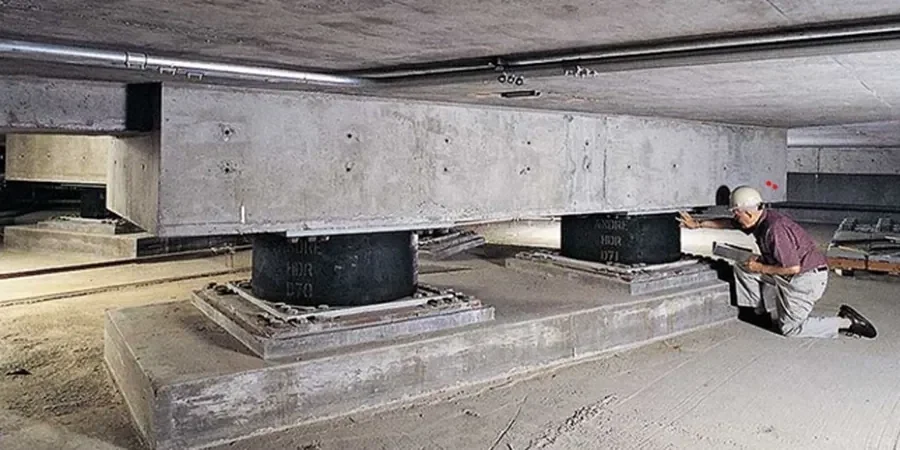
A Vs30 survey alone can shift a site from class D to class C and cut foundation reinforcement costs by 15%.
Service characteristics in Pasadena California
- Shear wave velocity (Vs30) via MASW or crosshole.
- SPT N-values corrected for overburden and energy ratio.
- Atterberg limits and natural moisture content on fine-grained layers.
- Cyclic triaxial tests on undisturbed samples when soft clay is present.
Live process video
Critical ground factors in Pasadena California
The most common mistake we see in Pasadena is assuming a shallow spread footing works on every lot. Builders often skip a proper seismic foundation design because the soil looks firm at the surface. But a few meters down, the same lot can have loose sand lenses or a soft clay layer that amplifies ground motion. We have measured 30% higher spectral acceleration on sites with just 3 meters of soft clay over dense sand. That difference can crack a slab-on-grade or tilt a retaining wall. A detailed site investigation that includes Vs30 and liquefaction screening is the only way to avoid that risk.
Our services
We offer a complete suite of operations to support seismic foundation design in Pasadena. Each service is tailored to the local geology and code requirements.
MASW Vs30 Survey
Non-invasive vs30/" data-interlink="1">shear wave velocity profiling using a 24-channel seismograph. Output includes 1D and 2D velocity models for NEHRP site class assignment.
SPT Borings with Energy Calibration
Standard penetration tests at 1.5 m intervals with a calibrated safety hammer. N-values are corrected for rod length, borehole diameter, and energy ratio.
Cyclic Triaxial Testing
Undisturbed tube samples tested under cyclic loading to simulate earthquake shaking. Results define cyclic resistance ratio (CRR) for liquefaction evaluation.
Foundation Design Recommendations
We carry out allowable bearing capacity, estimated settlement under seismic loading, and reinforcement detailing for shallow or deep foundations.
Common questions
What is the first step in seismic foundation design for a home in Pasadena?
We start with a site visit and a review of the USGS seismic hazard maps for the specific address. Then we perform a Vs30 survey or SPT boring to classify the site per ASCE 7-22. That tells us the design spectral acceleration values and the foundation type needed.
How much does seismic foundation design cost in Pasadena?
For a typical residential lot, the full investigation and report ranges between US$1,190 and US$4,580 depending on the number of borings, depth of testing, and whether cyclic triaxial tests are required. Commercial projects with deeper borings or multiple test locations fall at the upper end.
Do I need a seismic foundation design if my lot is on bedrock?
Even bedrock sites require verification. The Raymond fault zone has fractured rock and weathered zones that can still amplify motion. We have seen sites mapped as rock that actually had 5 meters of weathered granite with a Vs30 below 500 m/s, which puts them in site class C instead of B. A field survey removes the guesswork.
What codes does Pasadena enforce for seismic foundation design?
Pasadena adopts the 2021 International Building Code (IBC) with amendments from the California Building Standards Commission. ASCE 7-22 is the reference for seismic loads, and Chapter 18 of the IBC governs foundation design. We also follow ASTM D1586 for SPT and ASTM D4428 for crosshole seismic testing.