Pasadena California grew rapidly after the 1900s, with hillside neighborhoods carved into the San Gabriel Mountain foothills. The mix of ancient alluvial fans and steep colluvial deposits creates distinct failure mechanisms. A thorough slope stability analysis in Pasadena California must account for the region's seismic setting, where near-fault ground motions from the Raymond and Sierra Madre faults amplify shear stresses in unsaturated silty sands. The team integrates limit-equilibrium software with site-specific shear strength data from direct shear and triaxial tests. For cut slopes exposing weathered bedrock, the analysis also considers perched water tables during winter storms, a common trigger for shallow planar slides. This approach follows FHWA-NHI-05 guidelines and is backed by an ISO 17025-accredited laboratory.
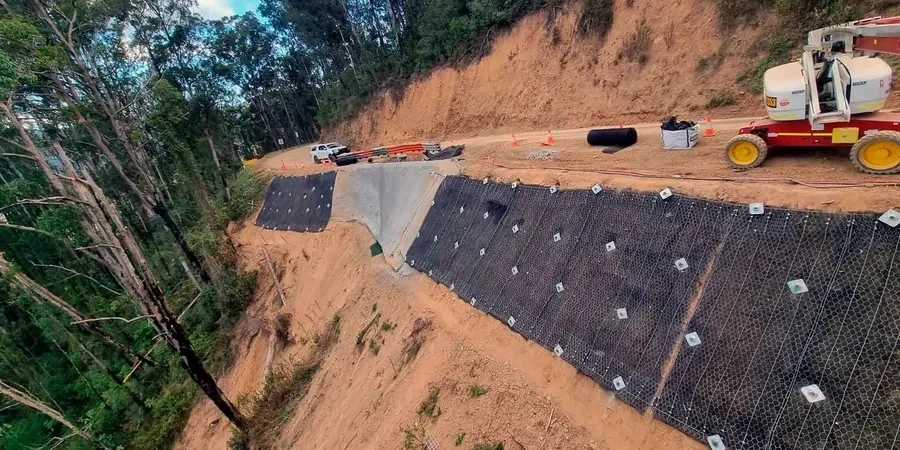
In Pasadena's hillside terrain, a 10 percent increase in soil moisture can drop the factor of safety below 1.1 during a moderate seismic event.
Service characteristics in Pasadena California
Critical ground factors in Pasadena California
A common mistake in Pasadena California is assuming uniform soil strength across a single hillside lot. Contractors often backfill the downslope side with imported material, creating a weak layer that the stability analysis misses if the model only uses native colluvium parameters. Without a proper stratigraphic profile — including Atterberg limits and compaction data — the calculated factor of safety can overestimate stability by 30 percent or more. The consequence shows up after the first wet winter: tension cracks open at the top of the fill, and the slope creeps. A reliable slope stability analysis in Pasadena California must sample across the entire failure envelope, not just the cut face.
Our services
Our slope stability analysis in Pasadena California covers the full spectrum of hillside geotechnics. Each study is customized to the site's geology, drainage, and seismic setting.
Limit-Equilibrium Modeling
Bishop, Spencer, and Morgenstern-Price analyses for circular and non-circular slip surfaces. Pseudo-static seismic loading per ASCE 7-16.
Shear Strength Characterization
Direct shear (ASTM D3080) and consolidated undrained triaxial (ASTM D4767) tests on undisturbed and remolded samples from the Pasadena foothills.
Seepage and Pore Pressure Analysis
Steady-state and transient seepage modeling using SEEP/W. Considers winter recharge and clay interbeds common in the San Gabriel alluvial fan.
Remediation and Stabilization Design
Recommendations for soil nails, tieback anchors, buttress fills, and subsurface drainage. Includes construction-level instrumentation monitoring.
Common questions
What is the typical factor of safety required for a slope in Pasadena California?
For static conditions, FHWA-NHI-05 recommends a minimum factor of safety of 1.5. Under pseudo-static seismic loading per ASCE 7-16, the minimum drops to 1.1. Local jurisdictions in Pasadena may require higher values for slopes adjacent to existing structures.
How much does a slope stability analysis cost in Pasadena California?
The cost typically ranges from US$1,390 to US$4,190 depending on the number of cross-sections, laboratory tests required, and site access difficulty. A basic residential lot with two cross-sections and direct shear tests falls near the lower end; a large development with multiple benches and seismic analysis approaches the higher end.
What triggers landslides in the Pasadena foothills?
Winter rainfall saturates the colluvial mantle, reducing soil suction and increasing pore pressure. The Raymond and Sierra Madre faults also generate moderate earthquakes (M 6-7) that can trigger deep-seated rotational slides. Old debris-flow deposits act as weak planes.
Do I need a slope stability study for a small retaining wall?
Yes, if the wall retains a slope steeper than 2:1 or if the retained height exceeds 6 feet. The analysis must check global stability of the wall-soil system, not just the wall's structural capacity. Pasadena building code references IBC Chapter 18 for this requirement.
How long does the analysis take from sample collection to report?
Typically 3 to 5 business days after laboratory testing is complete. If the site has complex stratigraphy requiring multiple borings, the full process including field work can extend to 10-12 business days.