A common mistake we see from contractors in Pasadena California is assuming that the brown silty sands and clays exposed during grading are uniform fill or alluvium. In reality, much of the hillside residential area between the Arroyo Seco and Eaton Canyon sits on deeply weathered granodiorite and gneiss, producing residual soils with abrupt lateral changes in plasticity and strength. If you classify the material solely by color or texture at the surface, you will likely miss clay layers that swell when wet or sand seams that ravel during excavation. We always recommend combining a thorough visual-manual classification per ASTM D2488 with index testing — specifically Atterberg limits and grain size distribution — before deciding on foundation type or slope cuts. This initial step often reveals that what looks like competent soil at the top is actually a collapsible or expansive profile once you sample 4 to 6 feet deeper, and that can change the entire earthwork plan.
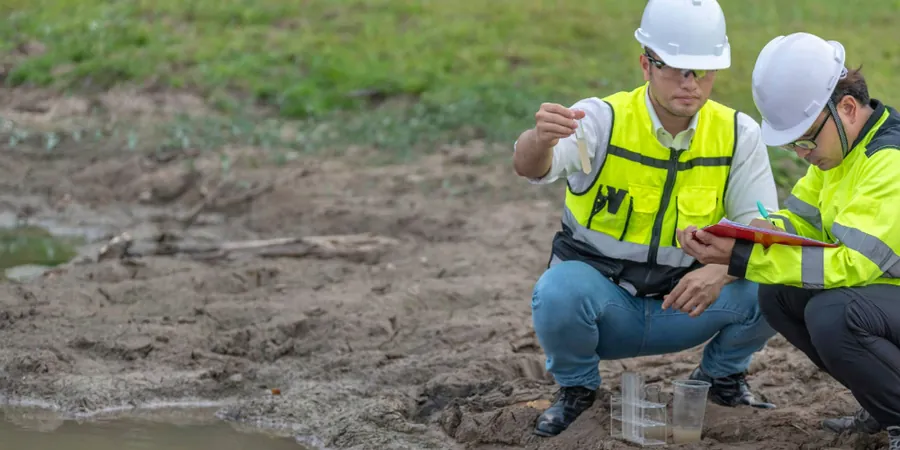
Residual soils in Pasadena often look competent at the surface but become collapsible or expansive just 4 to 6 feet deeper. Index testing is the only reliable way to catch the transition.
Service characteristics in Pasadena California
Critical ground factors in Pasadena California
Compare two Pasadena California neighborhoods: the alluvial fans of Linda Vista versus the residual slopes of the Lower Hastings Ranch area. In Linda Vista, soils behave more predictably — granular, well-drained, low shrink-swell. But on the Hastings Ranch side, where the granite has decomposed in place for millennia, you encounter residual clays that shrink and crack during the dry summer and then heave when the first rains hit. A house built on a foundation designed for the sandy profile will see differential movement within two years. That is exactly why we run a full residual soil characterization on every steep-lot project in these hills: to identify the transition depth from weathered rock to true soil and to measure the activity ratio of the clay fraction. Ignoring this step means accepting a 20-30% probability of slab distress within the first five years.
Our services
Our Pasadena geotechnical laboratory offers the following residual soil characterization operations, each tailored to the local geology:
Field Block Sampling & Logging
Hand-carved undisturbed block samples from test pits or shallow trenches, logged per ASTM D2488 with detailed description of structure, color, and moisture condition. Ideal for residual profiles where driven samplers often remold the material.
Index Property Testing Suite
Full set of Atterberg limits (liquid limit, plastic limit, PI), natural moisture content, and grain size distribution by sieve and hydrometer. Results classify the soil per USCS and identify expansive or collapsible tendencies.
Direct Shear & Unconfined Compression
Shear strength parameters (c', phi') on undisturbed specimens at field moisture and saturated conditions. Essential for slope stability analysis and foundation design in residual soils with inherited rock structure.
Collapse Potential & Swell Testing
Oedometer tests under controlled wetting to measure collapse strain and swelling pressure. Critical for Pasadena sites where residual clays overlie weathered bedrock and seasonal moisture changes trigger volume change.
Common questions
What is the difference between residual soil and transported soil in Pasadena?
Residual soil forms directly from the in-place weathering of the underlying bedrock — in Pasadena's case, mostly granodiorite and gneiss. Transported soil, like the alluvium in the Arroyo Seco floodplain, was carried by water or gravity and deposited elsewhere. Residual profiles retain the parent rock's relict structure but often have lower strength and higher plasticity at depth; transported soils tend to be more layered and uniform laterally. The distinction matters because residual soils require deeper sampling to find competent bearing material, while transported soils may have variable density layers that affect settlement.
How deep should I sample residual soil on a Pasadena hillside lot?
We typically recommend sampling to at least 4.5 meters (15 feet) below the proposed foundation grade, or to refusal on weathered rock, whichever comes first. The active zone where seasonal moisture changes affect strength extends 2 to 3 meters deep in Pasadena's clay-rich residual profiles. Below that, the material may be stronger but can still contain relict joints or decomposed seams that act as weak planes. A continuous soil profile log with SPT or hand-auger samples every 1.5 meters is standard for residential projects.
What laboratory tests are essential for characterizing residual soils?
The core suite includes natural moisture content (ASTM D2216), Atterberg limits (ASTM D4318), and grain size distribution with hydrometer (ASTM D422). For strength evaluation, we run direct shear (ASTM D3080) on undisturbed specimens at field moisture and saturated conditions. Collapse potential and swell tests (ASTM D4546) are added when the soil classifies as CL, CH, or SC with moderate to high plasticity. These tests together tell us whether the soil will shrink, swell, collapse, or stay stable under the planned load.