We set up a test pit on a residential lot near the Arroyo Seco and the first thing we noticed was the perched water table at just three feet. That shallow saturation is common in Pasadena, California, especially after winter rains, and it forces us to think about drainage before we even talk about foundations. Our geotechnical drainage design starts with field permeability tests using double-ring infiltrometers to measure infiltration rates in the native alluvial soils. On that same site we also deployed a portable pump test to estimate transmissivity, data that directly feeds the drainage layout. The goal is always the same — intercept water before it reaches the bearing stratum and route it safely away from the structure. We have seen too many slab-on-grade failures in this city that could have been avoided with a simple perimeter drain tied to a positive outfall.
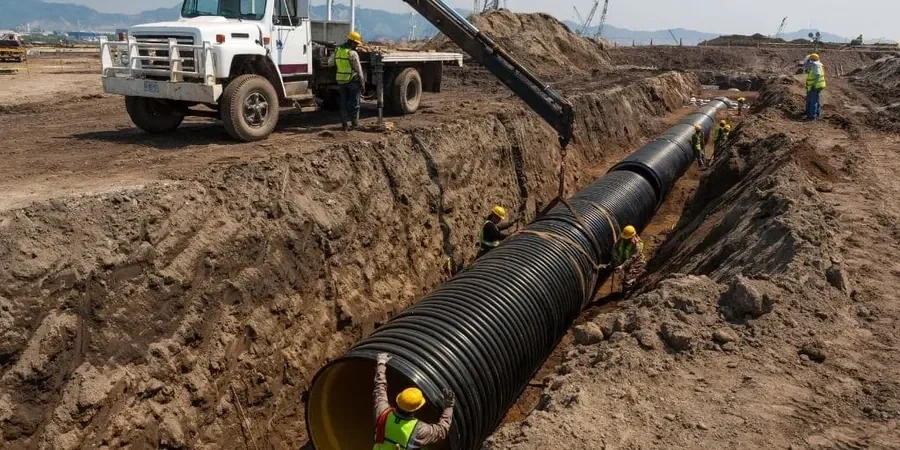
Shallow perched water tables at three feet depth are routine in Pasadena — drainage design must start with field permeability testing, not assumptions.
Service characteristics in Pasadena California
Critical ground factors in Pasadena California
Compare two neighborhoods: the Linda Vista area sits on older, well-drained terrace deposits, while the Eaton Wash corridor has young alluvium with clay lenses that hold water for weeks after rainfall. In Eaton Wash we have documented hydrostatic pressures equivalent to six feet of water head against basement walls during El Niño years. That pressure can crack a reinforced concrete wall if no drainage blanket is installed. Our geotechnical drainage design for those sites always includes a continuous drainage composite panel against the wall, connected to a perforated pipe at the footing level. Without it, the wall acts as a dam and the water finds the weakest joint. We have also seen differential heave in expansive clay zones where drainage was omitted — the soil swells unevenly and lifts a corner of the slab.
Our services
We offer two complementary drainage design operations tailored to Pasadena’s soil and rainfall conditions. Both are delivered with full field verification and construction-phase support.
Foundation Perimeter Drainage Design
We design perimeter drain systems for slab-on-grade and basement foundations, including perforated pipe sizing, filter aggregate specification, geotextile wrap selection, and positive outfall routing. Each design is calibrated to the site-specific soil permeability and water table depth measured in the field.
Slope and Retaining Wall Drainage Design
For cut slopes and retaining walls, we engineer subsurface drainage blankets, horizontal drains, and weep-hole systems that relieve hydrostatic pressure. We include stability checks for seepage conditions and specify cleanout ports for long-term maintenance access.
Common questions
What is the typical cost range for a geotechnical drainage design study in Pasadena?
The cost for a residential-scale geotechnical drainage design in Pasadena, California typically falls between US$760 and US$2.260. That range covers field permeability testing, analysis, and a full drainage plan with pipe sizing and outfall routing. Larger commercial sites or projects requiring multiple test pits may exceed the upper end.
Do I need a drainage design if my lot has a high water table?
Yes, and the sooner you address it the better. A high water table in Pasadena’s alluvial fans can cause hydrostatic uplift on slabs, lateral pressure on retaining walls, and long-term moisture migration into crawl spaces. A proper drainage design intercepts that water before it reaches the foundation, using perforated pipes and gravel blankets tied to a gravity outfall or a sump pump system.
How does Pasadena’s rainfall pattern affect drainage design criteria?
Pasadena gets roughly 20 inches of rain per year, but most of it falls between December and March. That concentrated rainfall saturates the soil quickly, especially in areas with clay lenses. We design for a 24-hour storm event with a 50-year return period per NOAA Atlas 14, and we size the drainage system to handle the peak runoff without surcharging. The system must also function during the dry months to prevent mosquito breeding in standing water.
Will the drainage system require maintenance after installation?
All subsurface drainage systems need periodic maintenance. We specify cleanout ports at every change in direction and at maximum intervals of 100 feet. For Pasadena’s conditions, we recommend inspecting the system every two years and flushing the pipes with a garden hose to remove sediment. If the system includes a sump pump, the pump should be tested quarterly and replaced every five to seven years.