In Pasadena, the contrast between the alluvial fans near the San Gabriel Mountains and the older terrace deposits closer to the Arroyo Seco creates a real challenge for foundations. A building on South Lake Avenue might sit on relatively uniform sands, while just a mile west near the Rose Bowl the soil profile can shift from stiff clays to loose silts within a few feet. That kind of variability is exactly what drives the need for a proper differential settlement analysis. When one part of a foundation settles more than another, cracks appear, doors jam, and structural damage becomes inevitable. We combine field investigation with lab testing to quantify those differences before they cause trouble.
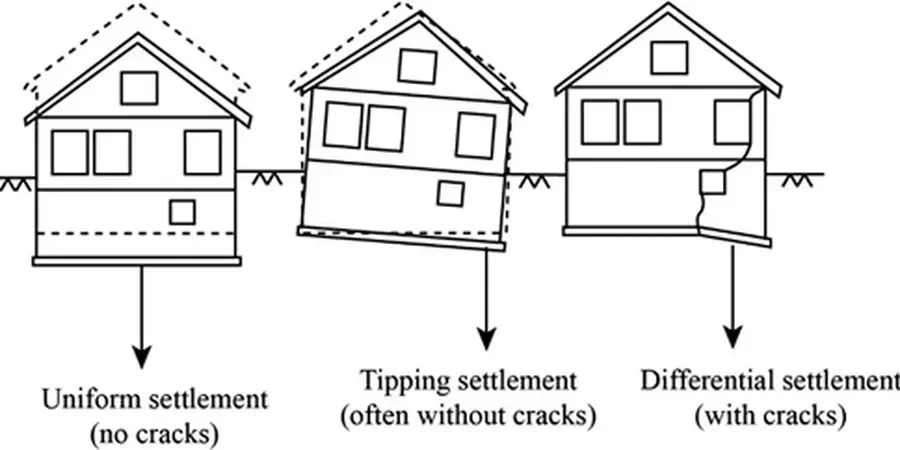
Differential settlement is not about how much the ground sinks; it is about how unevenly it moves under your foundation.
Service characteristics in Pasadena California
Critical ground factors in Pasadena California
The Raymond Fault cuts through the northern edge of Pasadena, and the area has historically experienced moderate seismic shaking. On top of that, many neighborhoods sit on deep alluvial deposits with groundwater tables as shallow as 10 to 15 feet. That combination of loose soils and seismic loading can trigger differential settlement during an earthquake, especially in areas with variable fill or undocumented grading from the early 1900s. We have seen cases where a house built on fill near the Eaton Canyon wash settled more than 3 inches while the adjacent structure on natural ground moved barely half an inch. A thorough differential settlement analysis identifies those risk zones before a foundation is designed.
Our services
To address differential settlement in Pasadena, we offer targeted operations that cover the full investigation and design cycle:
Consolidation Testing (Oedometer)
We run one-dimensional consolidation tests on undisturbed samples to determine compression index, preconsolidation pressure, and coefficient of consolidation. These parameters feed directly into settlement predictions for each soil layer.
Subsurface Variability Mapping
Using a combination of test pits, borings, and geophysical methods like GPR, we map lateral changes in soil type and thickness across the site. This identifies where differential movement is most likely to occur.
Foundation Settlement Analysis
We calculate immediate and consolidation settlement under proposed loads, including differential movement between adjacent columns or wall sections. The output includes recommended foundation type and depth adjustments.
Common questions
What is the typical cost for a differential settlement analysis in Pasadena?
For a standard residential or small commercial project, the cost ranges between US$700 and US$2,020, depending on the number of borings, laboratory tests required, and the complexity of the soil profile. Larger sites with multiple layers or seismic considerations may fall at the higher end.
How long does the analysis take from field work to report?
Field work typically takes one to two days for a small site. Laboratory consolidation tests require at least 7 to 14 days for the slow-drainage stages. The full report, including settlement calculations and recommendations, is delivered within 3 to 4 weeks from mobilization.
Can differential settlement be fixed after it has already occurred?
Yes, but the solution depends on the cause. Options include underpinning with helical piers or micropiles, soil grouting to stiffen loose zones, or slab jacking for concrete slabs. A post-construction analysis identifies which layers moved and guides the remedial design.
Do I need a differential settlement analysis for a small addition or remodel?
It depends on the soil conditions. In Pasadena, even modest additions can trigger differential movement if the new foundation bears on different soil than the existing one. We recommend at least a limited investigation with two borings and consolidation tests for any addition exceeding 400 square feet.
What is the difference between total settlement and differential settlement?
Total settlement is how much the entire foundation moves downward as a whole. Differential settlement is the difference in movement between two points, like one corner of a slab versus another. Differential settlement causes structural distress because it induces bending and shear forces that the building was not designed to handle.