We run the falling head test on a flexible-wall permeameter for fine-grained soils, and the constant head method on a rigid-wall cell for sands and gravels. In Pasadena California, where alluvial fans from the San Gabriel Mountains create highly variable soil layers, this distinction matters. A single boring might hit silty clay over loose sand. The lab setup uses de-aired water, back-pressure saturation, and a graduated pipette to track flow. We record readings every 15 seconds for fast sands, or every hour for tight clays. The result is k in cm/s, directly applicable to seepage analysis and dewatering design. Before we start the test, we cross-check soil classification via granulometría to pick the right method.
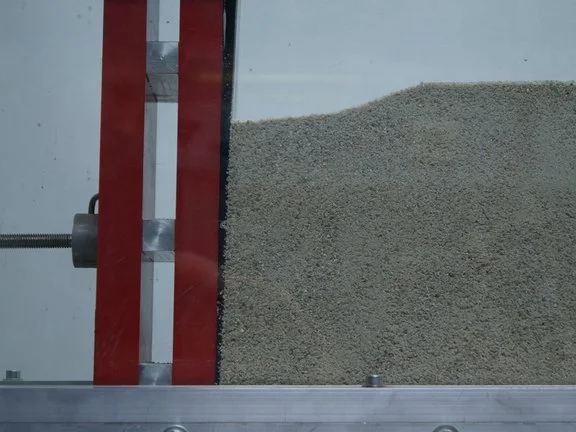
In Pasadena California, the alluvial fan deposits can vary k by two orders of magnitude within 50 feet horizontally. A single lab test is not enough.
Service characteristics in Pasadena California
Critical ground factors in Pasadena California
ASCE 7-22 and the California Building Code (CBC) require site-specific groundwater and seepage analysis for any foundation near the water table. In Pasadena California, the combination of shallow groundwater in the valley floor and steep slopes in the foothills creates dual risk: uplift on slabs and erosion of cut slopes. If the lab permeability test shows k > 1x10⁻⁴ cm/s, you need a dewatering plan or a drainage blanket. If k < 1x10⁻⁶ cm/s, you face long-term pore pressure buildup. Our ISO 17025 accredited lab delivers repeatable results that engineers use to size weep holes, sumps, and subdrains. We follow ASTM D5084-16a for falling head and ASTM D2434-19 for constant head.
Our services
We offer two standard configurations for the lab permeability test, depending on your soil type and project needs.
Falling head test (fine-grained soils)
For silts and clays with k below 1x10⁻⁴ cm/s. Uses flexible-wall permeameter with back-pressure saturation and B-check. Run under three effective stresses to model consolidation effects. Typical duration: 3 to 7 days.
Constant head test (coarse-grained soils)
For clean sands and gravels with k above 1x10⁻⁴ cm/s. Uses rigid-wall cell with constant hydraulic gradient. Flow measured by graduated cylinder or electronic balance. Test duration: 2 to 8 hours per specimen.
Common questions
What is the difference between falling head and constant head permeability tests?
The falling head test measures the time for water to drop through a fine-grained soil column under decreasing head. It works for clays and silts where flow is slow. The constant head test maintains a steady water level across a coarse-grained sample and measures the volume of outflow over time. It suits sands and gravels. Both follow ASTM standards but the equipment and calculation differ.
How much does a laboratory permeability test cost in Pasadena California?
The typical range for a single specimen is between US$410 and US$610, including saturation, B-check, and testing at three confining stresses. Additional specimens or special stress paths may raise the total. We recommend budgeting for at least two tests per soil unit to capture variability.
Why do I need a lab permeability test if I already have field infiltration data?
Field infiltration tests measure near-surface flow under unsaturated conditions. Lab tests measure saturated hydraulic conductivity under controlled stress and saturation. For foundation design below the water table or for seepage through a clay layer, the lab value is more reliable. In Pasadena California, the alluvium often has lenses of low-k clay that a field test might miss.
How long does it take to get results from a lab permeability test?
For a constant head test on sand, we deliver results in 3 to 5 business days. For a falling head test on clay, the process takes 7 to 14 business days because of the saturation and consolidation steps. We can prioritize rush orders for an additional fee.