Under ASCE 7-22, seismic site classification (A through F) directly controls base shear in design. For Pasadena California, where the Raymond and Sierra Madre faults create complex ground motion, assigning a uniform site class is rarely enough. That is why we perform seismic microzonation: a high-resolution mapping of Vs30, soil amplification, and liquefaction susceptibility across neighborhoods. This helps engineers avoid the costly error of treating a deep alluvial site like a rock outcrop. In many lots we find stiff young alluvium atop old terrace deposits, so we combine MASW profiles with MASW Vs30 surveys to refine the shear-wave velocity model before any structural analysis.
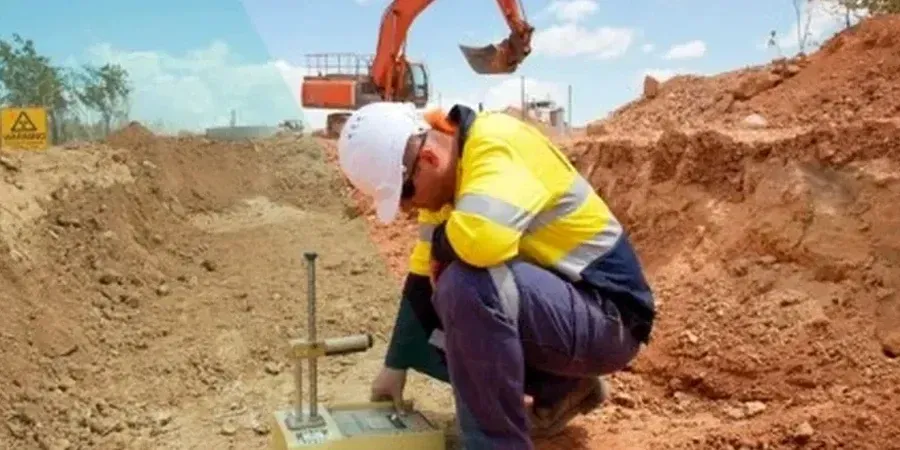
A single Vs30 measurement can misclassify a site; microzonation captures the three-dimensional variability that really controls ground motion.
Service characteristics in Pasadena California
Critical ground factors in Pasadena California
The difference between a lot in Linda Vista and one near the Arroyo Seco can be dramatic. On the alluvial fan, you get 20+ m of loose sand and silt with high amplification and liquefaction potential; up in the foothills, you are on weathered granodiorite with site class B. Seismic microzonation for Pasadena California maps those transitions block by block. Without it, a design based on a single boring 200 m away could miss a soft layer that doubles spectral acceleration. We have seen cases where a 30 m Vs30 profile revealed a hidden impedance contrast at 12 m that the building code default would have ignored entirely.
Our services
Our seismic microzonation service in Pasadena California includes three core components tailored to the local geology and code requirements.
Vs30 Profiling and Site Classification
We run MASW and HVSR surveys to determine the time-averaged shear-wave velocity in the upper 30 m, then assign the correct NEHRP site class (B through E). This satisfies ASCE 7-22 Chapter 20 requirements for any structure in Seismic Design Category D or above.
Liquefaction Hazard Zonation
Using SPT and Vs-based triggering methods (Youd & Idriss, 2001), we map the probability of liquefaction-induced settlement and lateral spread across the property. This is critical for Pasadena California because historic channels of the Arroyo Seco are filled with loose granular soils.
Ground Response Analysis
We perform one-dimensional equivalent-linear site response using DEEPSOIL to compute surface acceleration spectra and amplification factors. The output includes deaggregated spectral accelerations at 0.2 s and 1.0 s, directly usable for structural design per IBC 2021.
Common questions
What is the difference between a standard geotechnical report and seismic microzonation?
A standard report usually assigns one site class (e.g., D) to the entire property based on a single boring. Seismic microzonation maps variability: it shows where Vs30 changes, where amplification peaks, and where liquefaction risk is highest. In Pasadena California, a lot that straddles an old stream channel and a terrace deposit can have two different site classes within 50 m.
How much does seismic microzonation cost in Pasadena California?
For a typical residential or small commercial lot, the cost ranges from US$4.800 to US$14.900 depending on the number of MASW lines, HVSR stations, and the depth of investigation. Larger sites or projects requiring full ground response analysis fall at the higher end of that range.
Do I need microzonation for a single-family home in Pasadena?
Not always, but if the house is in a high-amplification zone (e.g., near the Arroyo Seco or on deep alluvium), the IBC minimum design may underestimate spectral accelerations. We recommend it for homes over two stories, or when a previous boring showed soft soils deeper than 10 m. It can reduce foundation costs by avoiding over-design.
What standards do you follow for the MASW survey?
We follow ASTM D4428 for crosshole and downhole testing, plus the NEHRP guidelines for Vs30 determination. The dispersion curves are inverted using a layered earth model, and we validate the profile with at least one borehole or CPT in the same lot. All results are reported in compliance with ASCE 7-22 Chapter 20.