In Pasadena, the alluvial fans and ancient debris flows from the San Gabriel Mountains create a complex subsurface — layers of sand, gravel, and clay that vary sharply over short distances. That variability makes VS30 a critical parameter for seismic design here. We use MASW (Multichannel Analysis of Surface Waves) to map shear wave velocity profiles non-invasively, giving engineers the site class data they need without drilling every corner of the lot. The method works well in Pasadena's urban infill projects where access is tight and noise regulations limit heavy equipment. For deeper stratigraphy we often combine it with a microtremor HVSR survey to validate the bedrock depth estimate.
A single velocity reversal can shift a building’s seismic site class from D to C — and change the entire lateral force design.
Service characteristics in Pasadena California
Critical ground factors in Pasadena California
Pasadena sits in a seismically active zone with several active faults nearby, including the Raymond and Sierra Madre fault systems. The alluvial basin can amplify ground motion significantly — a phenomenon documented in the 1987 Whittier Narrows earthquake where the soft sediments channeled shaking toward the surface. Without a proper VS30 determination, a project may underestimate the site amplification factor and design for the wrong lateral forces. That gap can lead to non-ductile detailing or insufficient base shear capacity. We flag these risks in our reports and, when the MASW indicates a soft profile, we recommend a microzonification study to refine the site response.
Our services
We carry out two complementary MASW service levels to match project phase and budget. Both include field acquisition, inversion processing, and a signed engineering report.
Standard MASW – VS30 for Seismic Site Class
Single 2D profile along one array line, processed to a 1D velocity log with VS30 value. Suitable for most building permits and IBC compliance in Pasadena. Includes site class letter designation per ASCE 7 Table 20.3-1.
Advanced MASW – 2D Velocity Cross-Section
Multiple overlapping array lines that produce a 2D shear wave velocity cross-section. Used for differential settlement studies, liquefaction triggering analysis, and foundation design in variable ground like the old arroyo channels beneath Pasadena.
Common questions
How does the MASW method work for VS30 determination in Pasadena?
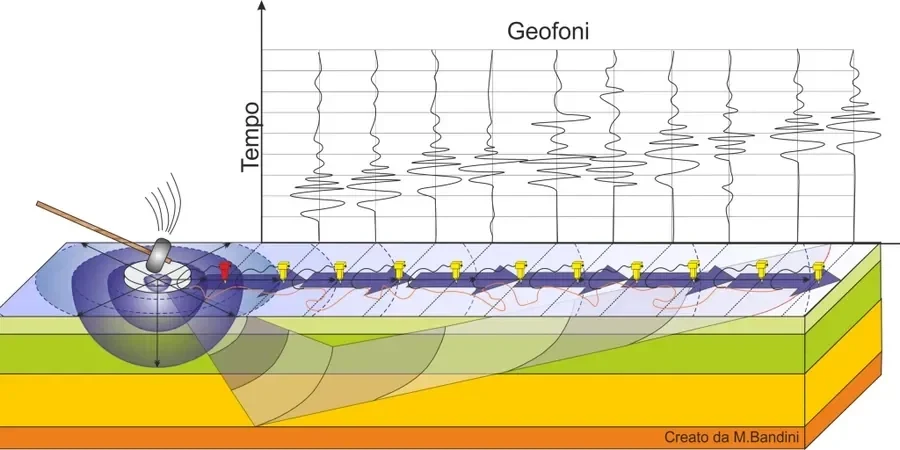
We place a 24-geophone array on the ground and generate surface waves with a sledgehammer. The geophones record the wave arrival times at known distances; software inverts the dispersion curve to produce a 1D shear wave velocity profile. The averaged velocity over the top 30 meters gives VS30, which directly determines the seismic site class (A through F) per ASCE 7.
What is the typical cost of a MASW survey in Pasadena California?
A standard single-profile MASW survey in Pasadena costs between US$1,630 and US$2,710. That includes field mobilization, data acquisition, processing, and a report with VS30 and site class. Multi-profile or 2D surveys run higher depending on line length and site access.
What site classes are common in Pasadena based on MASW results?
Most of Pasadena's alluvial fan deposits fall into site class D (stiff soil) or C (very dense soil/soft rock). Areas near the San Gabriel Mountains foothills can hit class B (rock) where bedrock is shallow. The MASW profile clearly shows the transition — important for buildings near the fault zones.
Do I still need soil borings if I have MASW data?
MASW measures shear wave velocity but does not replace physical sampling. For a complete geotechnical investigation, we still recommend at least one boring per site to classify soil type, run index tests, and correlate the velocity profile to actual material. The two methods together give you velocity data plus soil classification — a powerful combination for foundation design.